
Starr County Court Records After a Jail Arrest
After an arrest in Starr County, a person may be booked into the Starr County Jail at 102 E. 6th Street in Rio Grande City. The jail record reflects custody status and intake information. The court record is different. It is created or expanded when a charging document is filed and the clerk can index the case. Starr County criminal filings involving felony and district-court matters route through the District Clerk, while District Attorney Gocha Ramirez is the elected prosecutor whose office reviews evidence and files or presents charges.
That timing explains why a jail result and a court result may not match on the same day. A booking can appear before a formal court case is indexed, and the booking wording can differ from the charge that is later filed. For custody status and booking-side detail, use jail inmate records. For booking-photo access and limits, use jail mugshots. Court records after an arrest should be read as the filed case record, not as a county mugshot gallery or a live jail roster.
Arrest, Booking, Magistration, and Court Records
The common path is arrest, transport, booking, magistration, prosecutor review, and filing. At booking, jail staff confirm identity, inventory property, capture fingerprints or photographs according to agency policy, screen for medical and safety needs, and create a custody entry. That booking entry may list arresting agency, booking charge language, hold status, and release outcome if the information is available to the public.
Texas Code of Criminal Procedure Article 15.17 requires the arrested person to be taken before a magistrate without unnecessary delay and not later than 48 hours after arrest. At that appearance, the magistrate gives warnings, addresses rights, and may set bond or conditions. After that, the prosecutor decides what to file, whether to amend or reduce the accusation, and whether a felony should be presented to a grand jury.
The court case may lag behind the jail booking because clerks do not create a full case record until a case is opened, filed, or otherwise received. A very recent arrest may be visible through VINELink or confirmed by the sheriff phone line before it is visible in re:SearchTX or clerk records.
How to Find Starr County Court Records After an Arrest
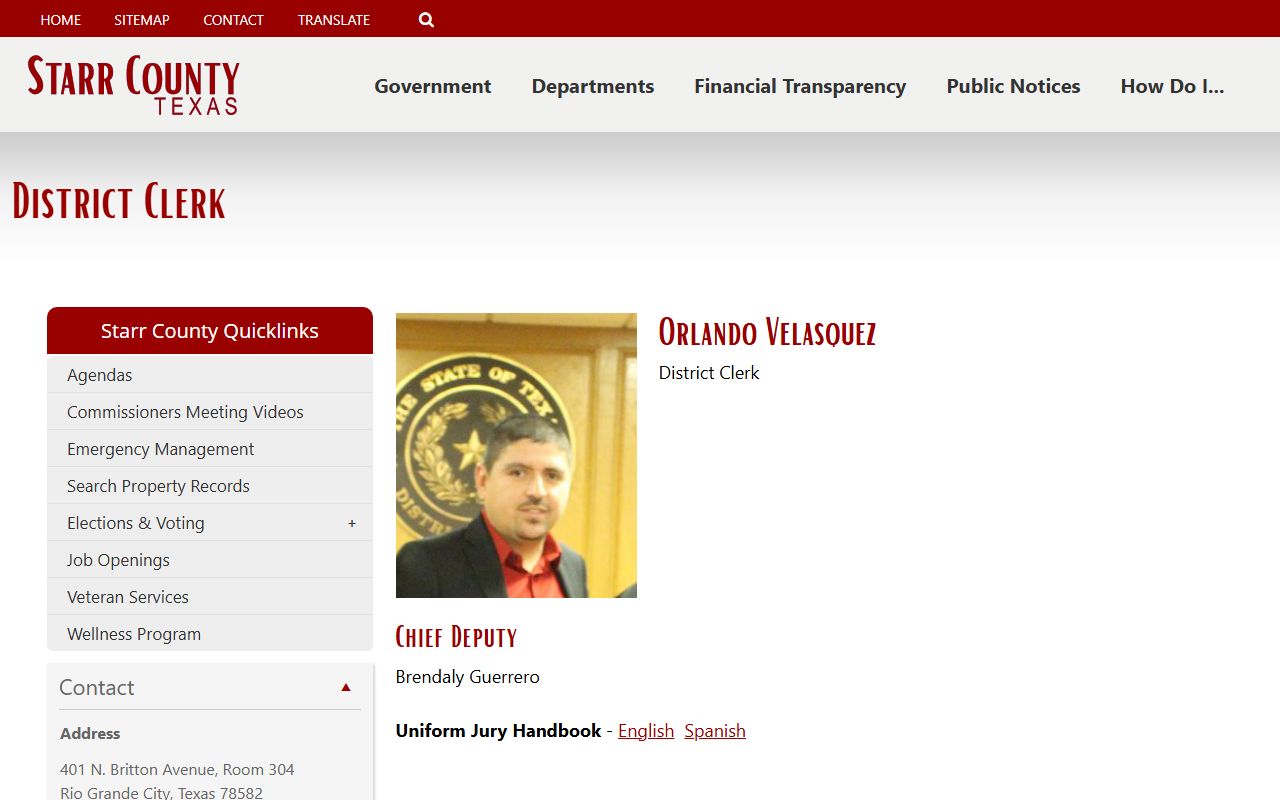
For felony or district-court matters, the local custodian is the Starr County District Clerk at 401 N. Britton Avenue, Room 304, Rio Grande City, TX 78582. The clerk page lists phone 956-716-4800 ext. 8482 and fax 956-487-8493. Starr County also publishes local pages for the 229th District Court and 381st District Court. Texas re:SearchTX is the statewide court access system for participating Texas courts, documents, hearing information, case tracking, and alerts, though full case detail can depend on sign-in, role, court participation, and document permissions.
- Confirm the person was booked locally through VINELink or the Starr County Sheriff's Office phone line at 956-487-5571.
- Collect the exact name, date of birth if known, arrest date, arresting agency, and any booking or agency case number.
- Contact the District Clerk for felony or district-court filings, or search re:SearchTX if the case is available there.
- Read each filed charge separately, including charge level, charging document, bond order, court setting, disposition, and any dismissal or amendment.
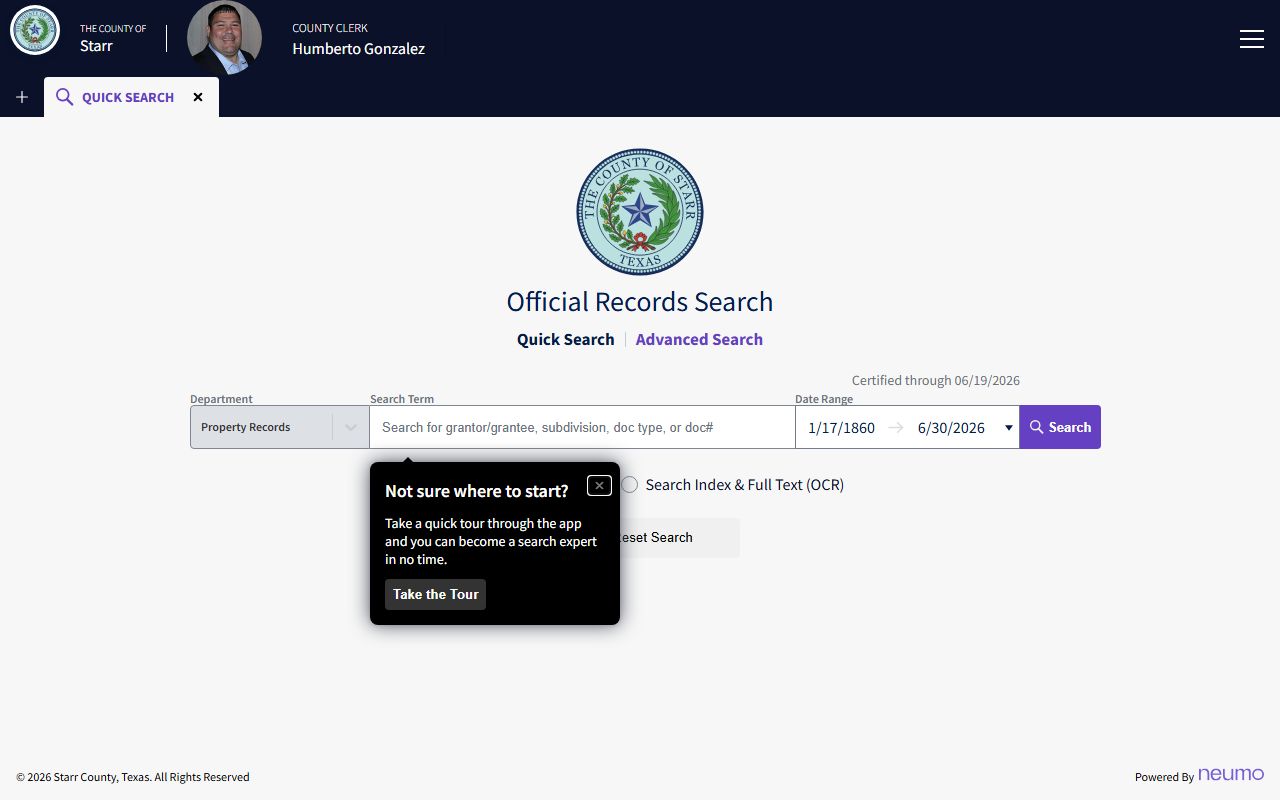
The Starr County official records search is visible online and offers search-scope controls such as index-only and index plus full-text OCR searching. It is not confirmed as a criminal docket for jail charges, so it should not replace the District Clerk or re:SearchTX for criminal case access. Use it only for the county official-records scope it presents, and verify criminal case status through the clerk or court system.
The image below comes from the Starr County District Clerk contact page, the county source for district-court record contact information.
How Charges Get Filed After an Arrest: Complaint, Information, and Indictment
Booking charges are arrest allegations recorded during intake. Court charges are formal accusations filed in a court record. A prosecutor may file a complaint or information, amend a charge after reviewing reports, reduce a charge based on available proof, dismiss a count, or present a felony to a grand jury for indictment. The prosecutor's office is separate from the clerk: the District Attorney prosecutes, while the clerk maintains the filed record.
| Document | Who Uses It | What It Usually Means | Starr County Access Point |
|---|---|---|---|
| Complaint | Officer, complainant, or prosecutor | A sworn allegation that can begin lower-level or preliminary proceedings. | Ask the court clerk or arresting agency for the filed document or related case number. |
| Information | Prosecutor | A prosecutor-filed charging document, often used where an indictment is not required or has been waived. | District Clerk or appropriate county-level clerk, depending on court and offense level. |
| Indictment | Grand jury | A grand-jury charging document, commonly tied to felony prosecution. | District Clerk records for felony district-court cases. |
Charge Status in Court Records After an Arrest
Charges can change after Starr County jail booking. A jail entry may reflect what an officer used at intake, while the case record reflects what the prosecutor filed and what the court accepted. Read every count by status. One charge can be pending while another is dismissed, reduced, amended, or disposed by plea or trial.
| Status | What It Means | Why It Matters |
|---|---|---|
| Pending | The charge has been filed or remains active but has not reached final disposition. | Court dates, bond conditions, and attorney filings may still change the record. |
| Amended / Reduced | The prosecutor or court changed the charge, or the case moved to a lesser offense. | The original booking language may remain in jail paperwork even when the filed case changes. |
| Dismissed | The charge ended without a conviction on that count. | A dismissal does not automatically remove every arrest or booking record from public systems. |
| Nolle Prosequi | The prosecutor declines to continue that charge or count. | It is a prosecution decision that should be confirmed from the filed court record. |
| Disposition | The final outcome, such as conviction, acquittal, deferred adjudication, dismissal, or plea. | Disposition is the key distinction between an unresolved accusation and a completed case result. |
Search and Access Channels for Starr County Arrest Court Records
Several systems can be relevant, but they do not answer the same question. Start with the system that matches the record type.
| Channel | Use It For | Limit |
|---|---|---|
| Starr County District Clerk | Felony and district-court case records, filed charges, cause numbers, settings, and copies. | Online detail may be limited; older paper files may require clerk assistance. |
| re:SearchTX | Statewide Texas court access, case tracking, hearings, documents, and alerts where available. | Access may require sign-in and depends on court participation and permissions. |
| Starr official records portal | Official-records searching with index-only or index plus OCR scope controls. | Not confirmed as a criminal docket for jail charges. |
| Starr County Sheriff's Office | Custody status, jail booking confirmation, booking sheet requests, and VINELink direction. | Not the custodian of filed court case records. |
The image below comes from the Starr County official records search portal, a separate records search interface rather than a confirmed criminal case index.
Bond and Release After an Arrest
Bond is usually addressed at or after Article 15.17 magistration. VINELink may help confirm custody, but the Starr County sheriff page does not publish a public bond table. A person can have a bond amount and still remain in custody because of another warrant, federal hold, ICE detainer, parole or blue warrant, transport status, or court order. Confirm the amount, bond type, and every hold before assuming release is available.
| Bond Type | How It Works |
|---|---|
| Cash Bond | Money is paid directly to secure release. Starr County payment methods and hours should be confirmed with the jail or court before bringing funds. |
| Surety Bond | A licensed bail bond company posts the bond for a fee and guarantee. The bond must cover each case or hold that blocks release. |
| PR / Own Recognizance | The court releases the person on written promise and conditions rather than a full cash deposit. |
| No-Bond Hold | Release is not available until another court or agency clears the hold, warrant, detainer, or order. |
Warrants That Lead to an Arrest
No official Starr County active-warrant search portal was found on the county site during research. Warrants can still be part of the jail population. A bench warrant, capias, parole warrant, federal warrant, out-of-county warrant, or ICE detainer can result in booking or continued custody. For district matters, call the District Clerk at 956-716-4800 ext. 8482. For sheriff-held custody questions, call 956-487-5571 or use the sheriff's office address at 102 E. 6th Street. A missing online result does not prove that no warrant exists.
Charges vs. Convictions
An arrest and a filed charge are not convictions. Court records after a jail arrest often begin as accusations. A conviction requires a guilty plea, verdict, or other qualifying adjudication. Treat charge listings, especially recent ones, as case activity that must be followed to disposition.
| Charge | Conviction | |
|---|---|---|
| Stage | Accusation filed or listed in the case record. | Final result after plea, verdict, or qualifying adjudication. |
| Proof Standard | Usually begins from probable cause and prosecutor filing decisions. | Requires proof beyond a reasonable doubt or an accepted plea. |
| Public Record | Often public unless sealed, restricted, juvenile, confidential, or otherwise excepted. | Often public unless sealed, expunged, restricted, or confidential by law. |
| Practical Use | Shows what is alleged and pending. | Shows the final criminal case result on that count. |
Sealed vs. Expunged Arrest Records
Texas Code of Criminal Procedure Chapter 55A governs expunction of criminal records. Expunction and sealing are not the same thing, and neither happens simply because a person wants a record removed. Eligibility depends on the case outcome, timing, offense type, and court order. If a Starr County arrest is dismissed, acquitted, pardoned, or otherwise eligible, the clearing route runs through legal process and court orders, not through a website deletion request.
| Sealed / Nondisclosed | Expunged | |
|---|---|---|
| Visibility | Hidden from many public searches but not necessarily erased. | Destroyed, returned, or treated as no longer available as allowed by the court order. |
| Law Enforcement | Some government or criminal-justice access may remain. | Access is much more limited and controlled by the expunction order and law. |
| Eligibility | Depends on Texas nondisclosure law, disposition, waiting periods, and offense limits. | Depends on Chapter 55A categories such as acquittal, pardon, certain dismissals, or other eligible outcomes. |
| Effect on Court Records | Public case access may be restricted. | Agencies named in the order must handle records according to the expunction order. |
Background Check Considerations
Casual court lookups are not the same as legally compliant background checks. Employers, landlords, insurers, lenders, and other regulated users must follow the Fair Credit Reporting Act and any other laws that apply to their purpose. A name match in court records after an arrest should be verified by identifiers, official copies, and disposition before anyone treats it as a final criminal history conclusion.
Important: Starr County Inmate Population is not a consumer reporting agency and cannot be used for FCRA-covered decisions.
Restricted Court Records After an Arrest in Starr County
Texas Government Code Chapter 552 makes public information available unless an exception or confidentiality rule applies. Restrictions can affect juvenile records, sealed or expunged cases, medical and mental-health details, protected victim information, active law-enforcement files, security-sensitive jail information, and records covered by a court order. Section 552.108 can protect law-enforcement information when release would interfere with detection, investigation, or prosecution, and Section 552.101 protects information made confidential by other law.